
Medium
The variation of magnetic susceptibility $(\chi )$ with temperature for a diamagnetic substance is best represented by:
- A
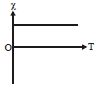
- B
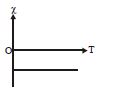
- C
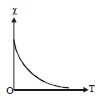
- D
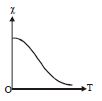
Explore More
Similar Questions
$A$ sample of paramagnetic salt contains $2 \times 10^{24}$ atomic dipoles each of dipole moment $1.5 \times 10^{-23} \text{ J T}^{-1}$. The sample is placed under a homogeneous magnetic field of $0.6 \text{ T}$ and cooled to a temperature of $4.2 \text{ K}$. The degree of magnetic saturation achieved is $20 \%$. What is the total dipole moment of the sample for a magnetic field of $0.9 \text{ T}$ and a temperature of $2.8 \text{ K}$ (in $\text{ J T}^{-1}$)?
$A$ paramagnetic salt contains $2 \times 10^{26} \, m^{-3}$ atomic dipoles. Each dipole has a magnetic moment of $1.5 \times 10^{-23} \, A \cdot m^2$. What is the saturation magnetization?
Easy
View SolutionWhich of the following curves represents the variation of magnetic moment $(M)$ with temperature $(T)$ for a ferromagnetic material?
Medium
View Solution$A$ ball of superconducting material is dipped in liquid nitrogen and placed near a bar magnet.
$(i)$ In which direction will it move?
$(ii)$ What will be the direction of its magnetic moment?
$(i)$ In which direction will it move?
$(ii)$ What will be the direction of its magnetic moment?
Medium
View SolutionElectromagnets are made of soft iron because soft iron has
Vedclass Products
For Students
Vedclass Test Series
Mock tests in real JEE/NEET style with performance analysis. 5-day free trial.
Start Free TrialFor Teachers
Exam Paper Generator
Generate Set A/B/C/D exam papers from 7.5L+ questions in 2 minutes. 3 chapters free.
Try FreeFor Institutes
Online Exam Module
Live online exams with unlimited students, 360° analytics & white-label branding.
See Demo